-
 August 4, 2026Gemma King
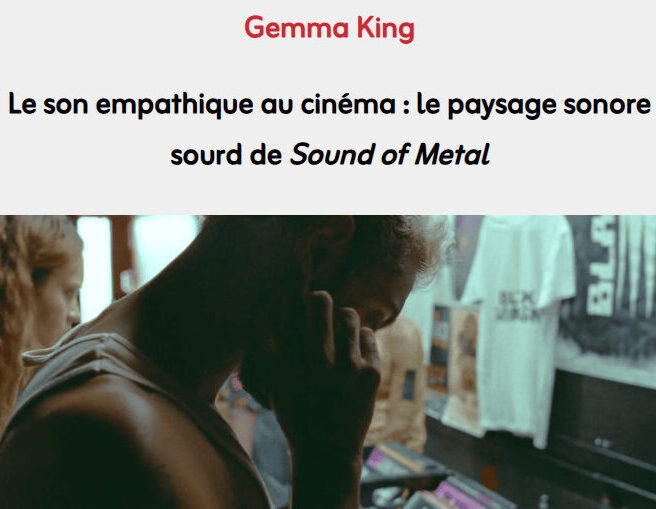
Le son empathique au cinéma : le paysage sonore sourd de Sound of Metal
To cite this article: King, G. (2026). ‘Le son empathique au cinéma : le paysage sonore sourd de Sound of Metal, Images Secondes, issue 6: Disability studies et cinéma : dévalider le regard, https://imagessecondes.fr/index.php/2026/07/king/.
This article is written in French, however an abridged version was translated into English in the open-access film journal Senses of Cinema.
Film can control not only what we hear, but how we hear it. Through a sound design that uses muffling, distortion, oscillations in volume, tinnitus-like overlays and abrupt cuts to silence, countless films and series attempt to convey an experience of deafness, for the benefit of a presumed hearing audience. This article proposes the term “empathic sound” to describe this immersive and audiocentric representation of hearing loss, focusing on the 2019 film Sound of Metal.
-
 June 28, 2026
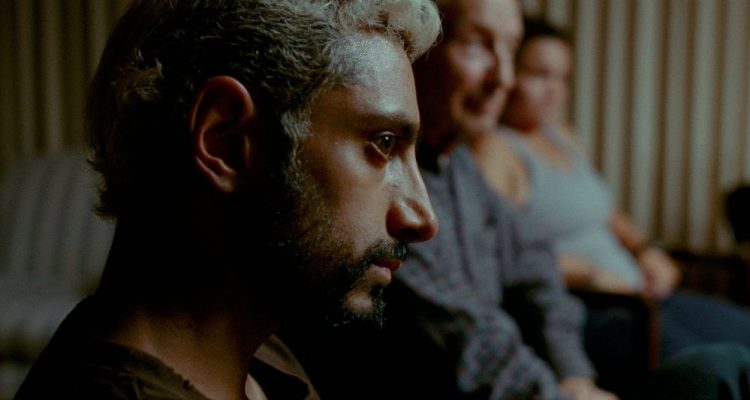
Empathic Sound in Film: The Deaf Soundscape of Sound of Metal
To cite this article: King, G. (2026). ‘Empathic Sound in Film: The Deaf Soundscape of Sound of Metal‘, Senses of Cinema, issue 117, https://www.sensesofcinema.com/2026/feature-articles/empathic-sound-in-film-the-deaf-soundscape-of-sound-of-metal/.
An expanded version of this article was originally published in French in the peer-reviewed journal Images Secondes.
Film can control not only what we hear, but how we hear it. Through a sound design that uses muffling, distortion, oscillations in volume, tinnitus-like overlays and abrupt cuts to silence, countless films and series attempt to convey an experience of deafness, for the benefit of a presumed hearing audience. This article proposes the term “empathic sound” to describe this immersive and audiocentric representation of hearing loss, focusing on the 2019 film Sound of Metal.
-
 April 7, 2026Gemma King; Hannah Holtzman
A language not their own: transnational production in ‘foreign’ dialogue
To cite this article: Holtzman, H., & King, G. (2026). A language not their own: transnational production in ‘foreign’ dialogue. Transnational Screens, 17(1), 1–6. https://doi.org/10.1080/25785273.2026.2634419.
This article is the introduction to a special issue of Transnational Screens co-edited by Gemma King and Hannah Holtzman.
Cultural and linguistic border-crossings are at the heart of transnational filmmaking practice, and language barriers pose unique challenges and opportunities to these crossings. Media production in a language one does not speak or understand may raise questions of authenticity, exploitation, and misrepresentation, while also allowing filmmakers to reach wider audiences and prompting reflection on the instability of national borders in production contexts. The articles in this special issue include case studies and broader examinations of multilingual and translingual trends in contemporary screen media production. The screen texts studied include documentary, narrative feature films, and streaming series made using American and French Sign Languages (ASL, LSF), Danish, English, French, Greek, Japanese, Kurdish, Navajo, Polish, Sámi, and Swedish. While these screen texts developed in response to different incentives and their productions involved diverse practical and ethical considerations, they share fundamental similarities in the language barriers encountered during production and acts of translation, multilingualism, and creative collaboration involved in overcoming these barriers. Informed by insights from Deaf Criticism, biopolitics, cultural studies, and transnational film theory, these articles intervene in cultural studies discussions of nation, language, and identity and the evolving discourse around representation and authenticity in screen media.
-
 March 18, 2026Gemma King
Between the superhero and the supercrip: Deaf Gain, exceptionalism and normality in contemporary film and television
To cite this article: King, G. (2026). Between the superhero and the supercrip: Deaf Gain, exceptionalism and normality in contemporary film and television. Continuum, 1–14. https://doi.org/10.1080/10304312.2026.2641206.
The inspirational ‘supercrip’ has long been a staple of deaf film narrative, but the 2010s and 2020s have seen an explosion in new screen portrayals of superheroes whose powers operate as extreme examples of Deaf Gain. Deaf superheroes both challenge the supercrip trope by resituating their skills in a fantastical context, and perpetuate it through their continued focus on exceptional bodies. Confronting this paradox through analyses of several recent characterizations, this article investigates the deaf superhero corpus’ potential to make a radical contribution to screen representation, not only through its portrayal of deaf exceptionalism, but of deaf normality.
-
 November 28, 2025Sofya Gollan
A call for change: sign language cinema and the politics of visual storytelling
To cite this article: Sofya Gollan (18 Nov 2025): A call for change: sign language cinema and the
politics of visual storytelling, Transnational Screens, DOI: 10.1080/25785273.2025.2590792.The relationship between sign language and the recorded moving image is unique – film is the only true medium for retaining the spatial, temporal, and visual nature of sign languages. Yet this linguistic integrity remains largely unrealised, as film and television industries maintain barriers that prevent Deaf creators from accessing positions of creative authority. I address this paradox: the screen’s capacity to perfectly capture sign languages versus the industry’s oblique and persistent refusal to entrust Deaf filmmakers with creative leadership. As a researcher and Deaf writer-director with over 20 years in the film industry, I examine how hearing culture’s hegemony maintains audiocentric practices through casting, cinematography, narrative tropes, and production hierarchies. Through production studies analysis, I propose crucial distinctions between authentic deaf casting and what I call ‘Deaf authorial control’.1 This article outlines a path toward authentic Deaf authorial control encompassing writing, directing, and producing roles – the key creative positions shaping screen texts from conception to distribution. This article challenges the current paradigm whereby Deaf stories are frequently told through hearing perspectives. This demands recognition that Deaf creators bring not only linguistic and cultural authenticity but also inherent visual approaches that benefit the artform itself, regardless of subject matter.
-
 November 28, 2025Sofya Gollan and Gemma King
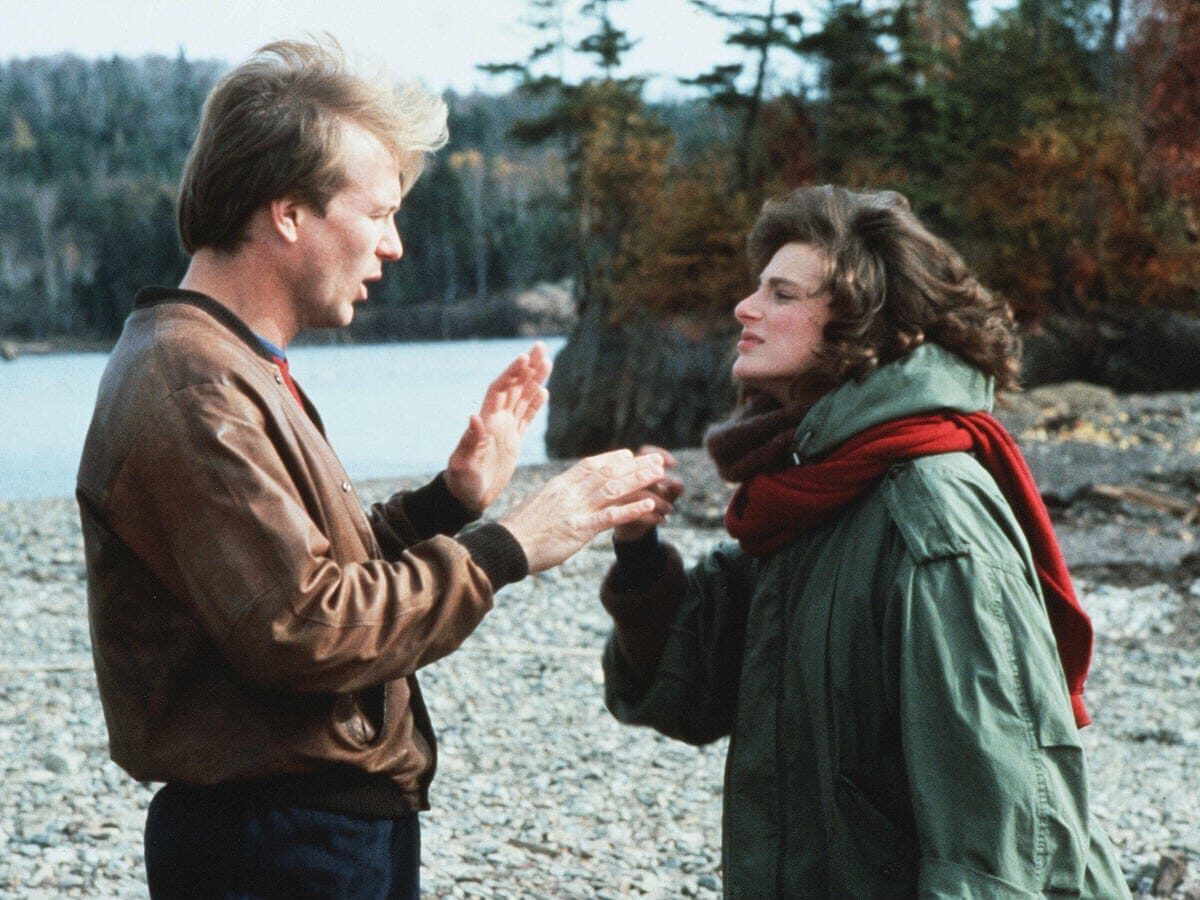
Lost without translation: Children of a Lesser God and sign language filmmaking under non-signing control
To cite this article: King, G., & Gollan, S. (2025). Lost without translation: Children of a Lesser God and sign language filmmaking under non-signing control. Transnational Screens, 1–13. https://www.tandfonline.com/doi/full/10.1080/25785273.2025.2573956.
Screen portrayals of deafness and sign language date back to the silent era. Yet with few exceptions, widespread ableism in film industries has led to the exclusion of Deaf creators from leadership roles and barred them from exerting authorial control. This has created a chronic language barrier whereby the vast majority of sign language screen content is written, framed and edited by non-signers, giving rise to tropes and techniques that perpetuate myths about deaf experience and obscure the semantic meaning of sign language dialogue. In these cases, sign becomes ‘foreign’ – incomprehensible, inaccessible, not of the creators’ world – despite the fact that sign languages are natural languages which originate from within every country and are therefore not ‘foreign’ at all. This article traces the connections between deaf history and cinema and critiques the norms of sign language representation by directors, writers, producers and cinematographers who do not understand the sign language they are representing. Through a study of the first major film to include a signing Deaf star, Children of a Lesser God (Randa Haines 1986), it reveals the limitations of authentic casting when a screen text is crafted by individuals for whom sign is a ‘foreign’ language.
-
 May 26, 2025Sofya Gollan, Gemma King and Sam Martin
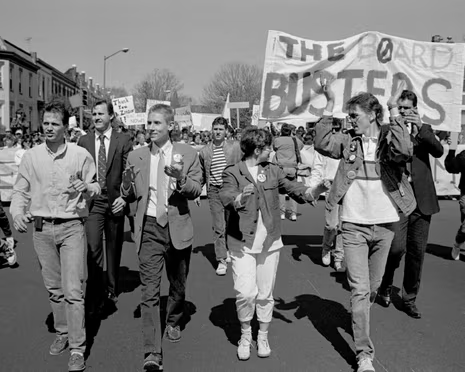
Deaf President Now! traces the powerful uprising that led to Deaf rights in the US – now again under threat
In March 1988, students of the world’s only Deaf university started a revolution that made national news. Now, the first film to document this historic uprising is screening on Apple TV+.
At the same time, American universities are grappling with the consequences of President Donald Trump’s war on diversity, equity and inclusion.
-
 May 8, 2025Gemma King
DIPLOMACY AND RESISTANCE: HOW DUNE SHOWS US THE POWER OF LANGUAGE- INCLUDING SIGN LANGUAGE
In Dune’s sandswept colonialist dystopia of the distant future, power is a force best handled – and transferred – surreptitiously. In a world of ultra-wealthy spice barons and interplanetary warfare, the greatest asset in both diplomacy and resistance is an intangible one: language. Nowhere is this clearer than in the films’ portrayal of sign language…
-
 January 23, 2025Gemma King and Sofya Gollan et. al.
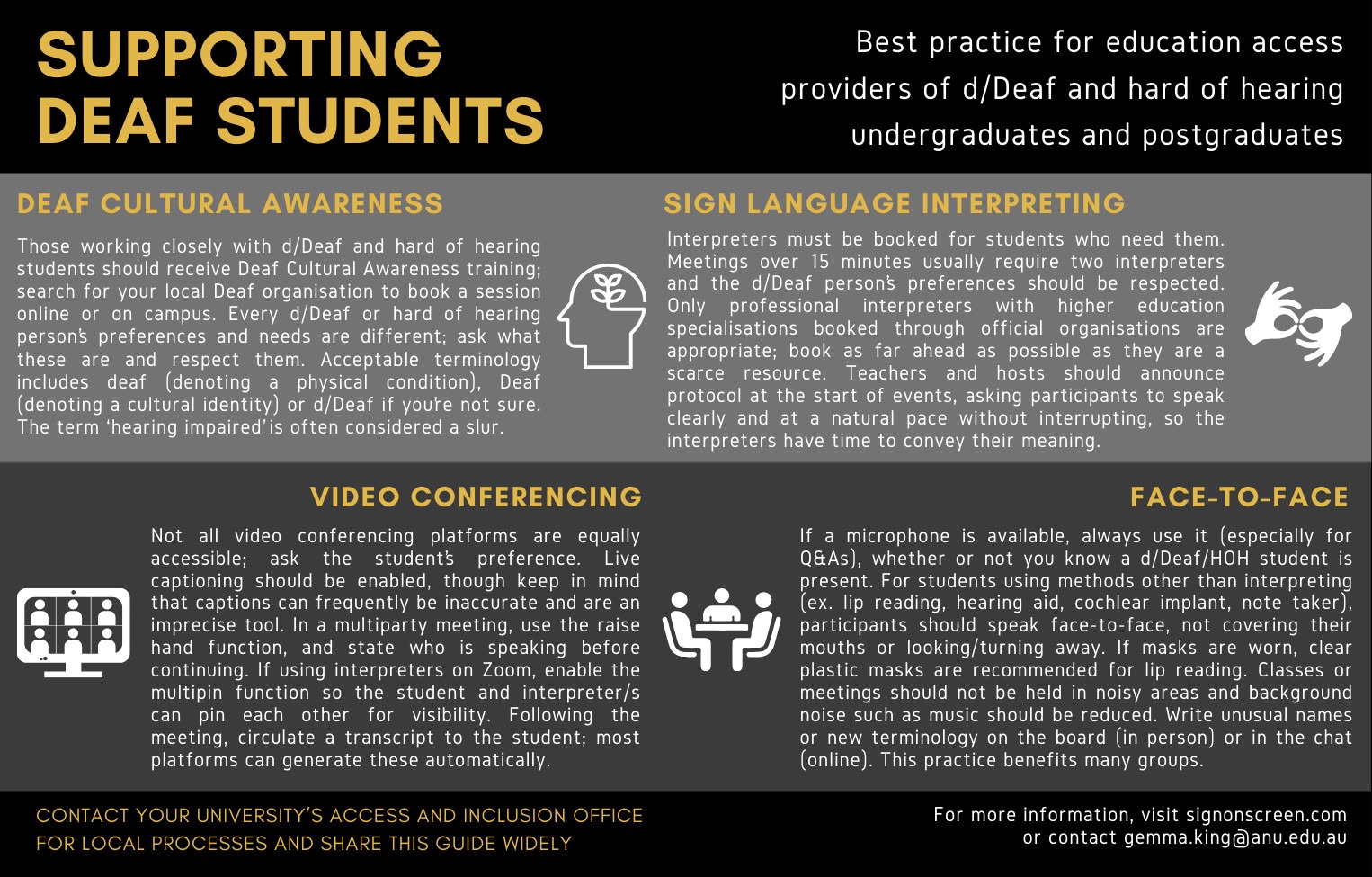
Open Use Guide: Supporting Deaf Students
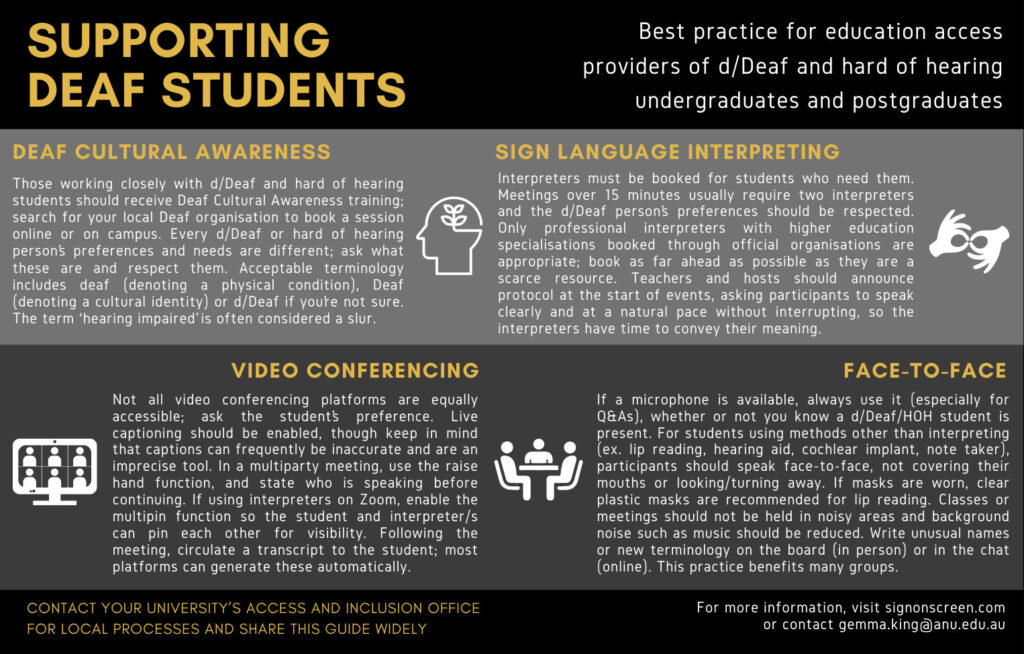
This guide was compiled by Deaf, HOH and hearing staff, students and interpreters at the Australian National University in 2024. Please use, print and share this guide freely across your university, school, workplace or other institution and ensure you credit Sign on Screen when citing it. Select ‘open in new tab’ for a larger view and to download the infographic or for a plain text version, click here. We urge educational institutions to incorporate these measures into all educational access provisions for d/Deaf and hard of hearing students and researchers and to pass these recommendations on to future education providers. For the original file or questions or suggestions about this guide, email gemma.king@anu.edu.au.
-
 January 31, 2024Gemma King
Sign Language, Multilingualism and the Postnational Popular Screen: From La Famille Bélier and Marie Heurtin to La Révolution
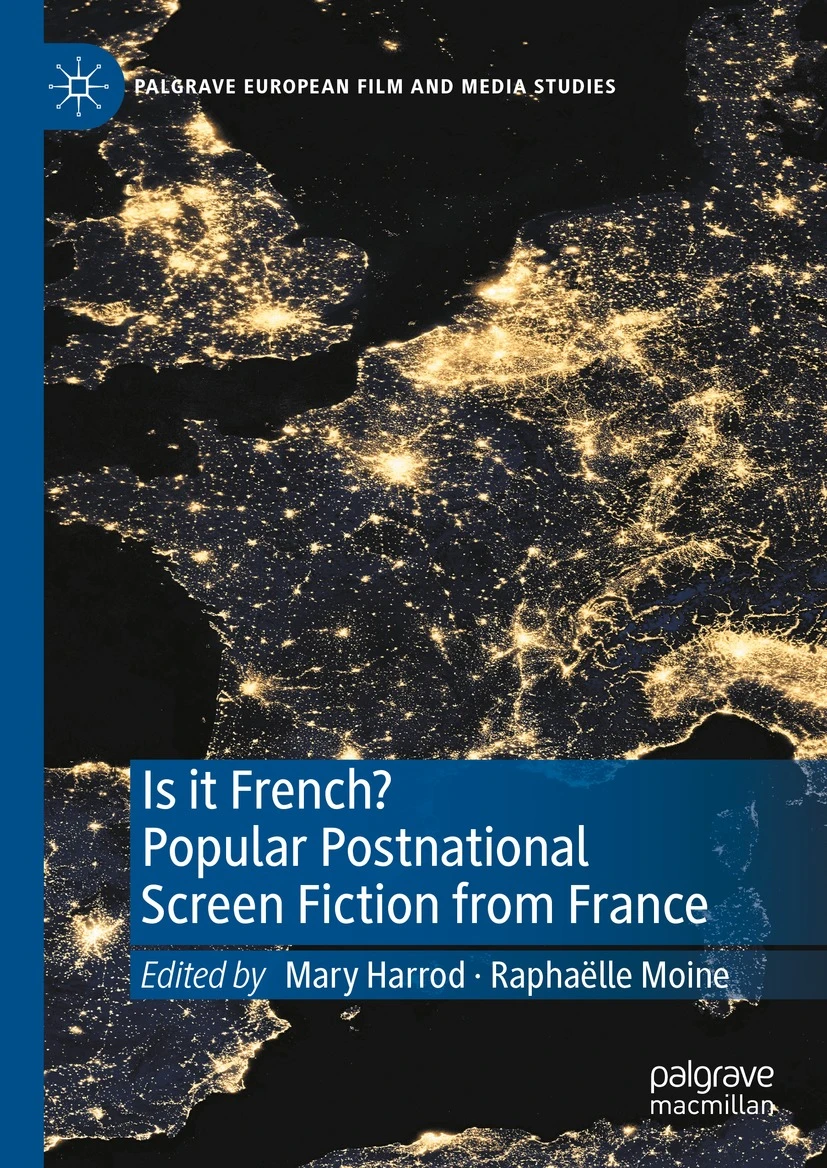
To cite this chapter: King, G. (2023). Sign Language, Multilingualism and the Postnational Popular Screen: From La Famille Bélier and Marie Heurtin to La Révolution. In: Harrod, M., Moine, R. (eds) Is it French? Popular Postnational Screen Fiction from France. Palgrave European Film and Media Studies. Palgrave Macmillan, Cham. https://doi.org/10.1007/978-3-031-39195-8_3.
Since the mid-2000s, the representation of multiple languages on French screens has increased significantly. However, an understudied element of this cinema is the growing corpus of films and series in French Sign Language (LSF). This chapter explores the evolution of multilingual French cinema in the twenty-first century. Placing Indigenous multilingualism within a broader translingual context, it focuses on the 2014 films La Famille Bélier/The Bélier Family (Eric Lartigau) and Marie Heurtin (Jean-Pierre Améris) and the 2020 series La Révolution/The Revolution (François Lardenois and Aurélien Molas) to examine the relationship between French Sign Language and French through a postnational lens. The chapter explores how these LSF texts challenge received norms of Frenchness, their connection to the French language and what ‘national language’ means for a nation that was always already multilingual.

Publications
-
-
-
-
-
-
-
-
-
Open Use Guide: Supporting Deaf Students
This guide was compiled by Deaf, HOH and hearing staff, students and interpreters at the Australian National University in 2024. Please use, print and share this guide freely across your university, school, workplace or other institution and ensure you credit Sign on Screen when citing it. Select ‘open in new tab’ for a larger view and to download the infographic or for a plain text version, click here. We urge educational institutions to incorporate these measures into all educational access provisions for d/Deaf and hard of hearing students and researchers and to pass these recommendations on to future education providers. For the original file or questions or suggestions about this guide, email gemma.king@anu.edu.au.
-